
AI City: Citizenship Education in the Age of AI
The AI City immersive platform has been developed to foster AI literacy – education on the responsible and informed use of Artificial Intelligence – in line with the principles of the European AI Act.
Making invisible intelligence visible
Education on Artificial Intelligence is typically hampered by the opacity and lack of transparency inherent in the technology itself.
AI City is a strictly visual representation of AI, which illustrates its impact on human society with an educational and informative purpose. An imaginary city, recreated in virtual reality, visualises the contexts in which AI is applied: the home, the school, the town square, the office, the factory, the hospital…
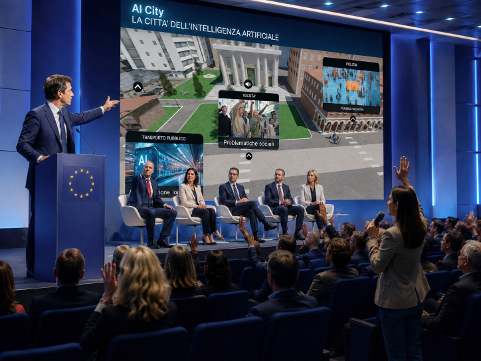
Thematic Locations
The city is a meta-location containing other locations, each dedicated to a specific application context
- The square (society, politics)
- The school (education)
- The self-driving car, the road and public transport (transport)
- The hospital (healthcare)
- The museum (culture)
- The shop (commerce)
- The police (law and order)
- The town hall (democracy)
- The office (work)
- The private home (law and order)
In addition to the main environments, for further exploration of specific sectors, there are other specific locations within the city that address different themes.
Risks and opportunities of AI
- The interplay between risks and opportunities lies at the heart of AI City’s educational process, but it is also central to the EU’s AI Act and AI Skills Strategy.
- Users explore the city across its various settings, discovering the risks associated with the introduction of AI – categorised into different levels by the AI Act – as well as the opportunities for social, economic and cultural development offered by the new technology. Red and green signage highlights the dangers and benefits in all contexts, from the home to the school, from the hospital to the town hall.
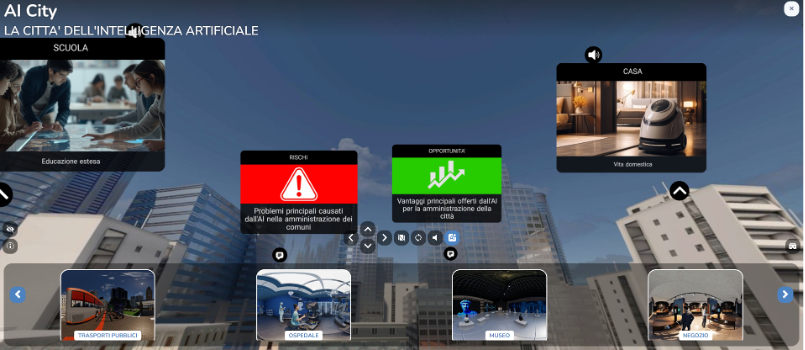
Asynchronous, Synchronous and Face-to-Face Training
The AI City platform can be used for training in various ways:
- Asynchronous – individual users enter the city and explore it on their own, discovering the content
- Synchronous – a trainer shares AI City online and uses it as an online teaching aid, also providing access links to course participants
- Face-to-face – In the workplace, on screen, the trainer delivers the lesson using AI City as an ‘immersive PowerPoint’ and engaging students in navigation and discussion
Cross-device
Developed to the international WebXR standard, which regulates access to virtual reality via web browsers, AI City is a cross-device platform, accessible via
- Personal computers
- Tablets and smartphones
- Immersive screens and projections
- Virtual reality headsets
Immersive education
The AI City experience is an immersive one. Artificial Intelligence is therefore presented alongside another emerging technology: virtual reality.
The learning journey is immersive, interactive and multisensory. The user explores the environment and encounters information in the form of multimedia hotspots.
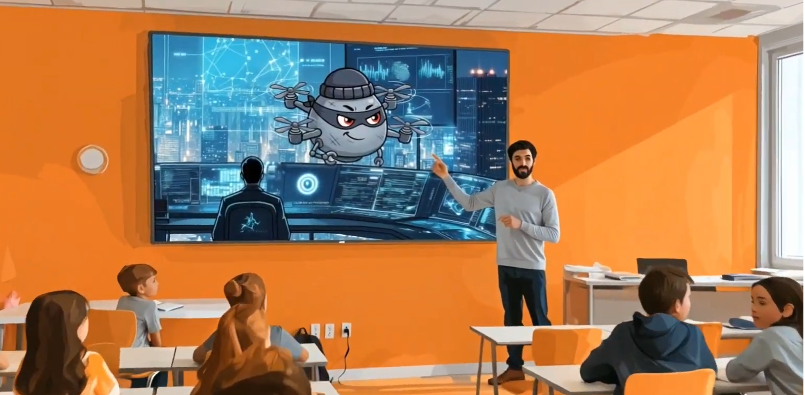
AI integrated into virtual exploration
AI City includes a conversational chatbot that allows users to explore the environment, access informative content, and receive guidance on the risks and opportunities associated with each AI application context
Interface Metaphor: the city
AI City adopts the city metaphor to explain the applications, technologies, risks and opportunities of AI to the educational community and the general public.
- The history of the Human-Machine Interface has been marked by famous metaphorical interfaces (scheumorphic: visually simulating reality)
- The most famous is the desktop interface (Desktop Metaphor), which underpinned the mass success of the personal computer (icons, folders, arrows, documents…).
- Artificial Intelligence, too, stems from a metaphor: Turing’s Imitation Game. The machine communicates by pretending to be a person.
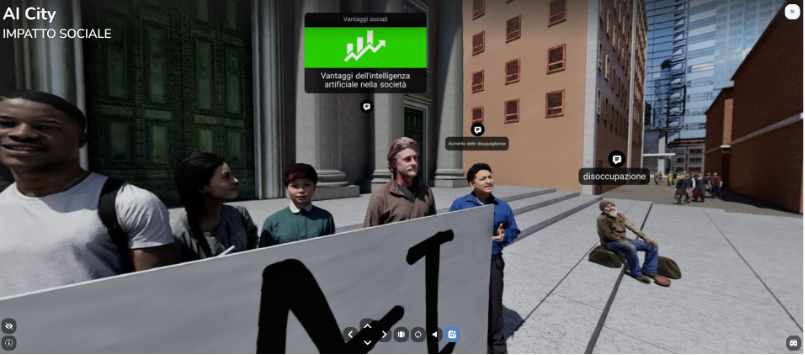
The anthropocentric approach
Whilst the dominant narrative on AI is based on product reviews from large corporations – and is, of course, also skewed by marketing – AI City aims to address Artificial Intelligence from an anthropocentric perspective. People are naturally at the heart of their city.
Activities, functions and environments revolve around them – the places where humanity lives, works, thinks, communicates and makes decisions. The perspective from which AI is presented is that of human society